
The Sweet Spot of Composable CRM
Building Custom CRM Apps in 30 Minutes with GenAI
We just ran an experiment that perfectly illustrates the future of enterprise software: combining a robust, composable core with the speed of Generative AI development.
The promise of AI coding assistants is massive, but anyone who has tried to build a full-stack application from scratch knows the reality: while the code generation is impressive, handling the infrastructure—authentication, database setup, API security, and deployment—is still a heavy lift. There is often a gap between a cool demo and a production-ready tool.
However, we found a sweet spot. By letting Stood CRM handle the heavy lifting (the "backend") and using an AI coding assistant to build the interface, we achieved something remarkable.
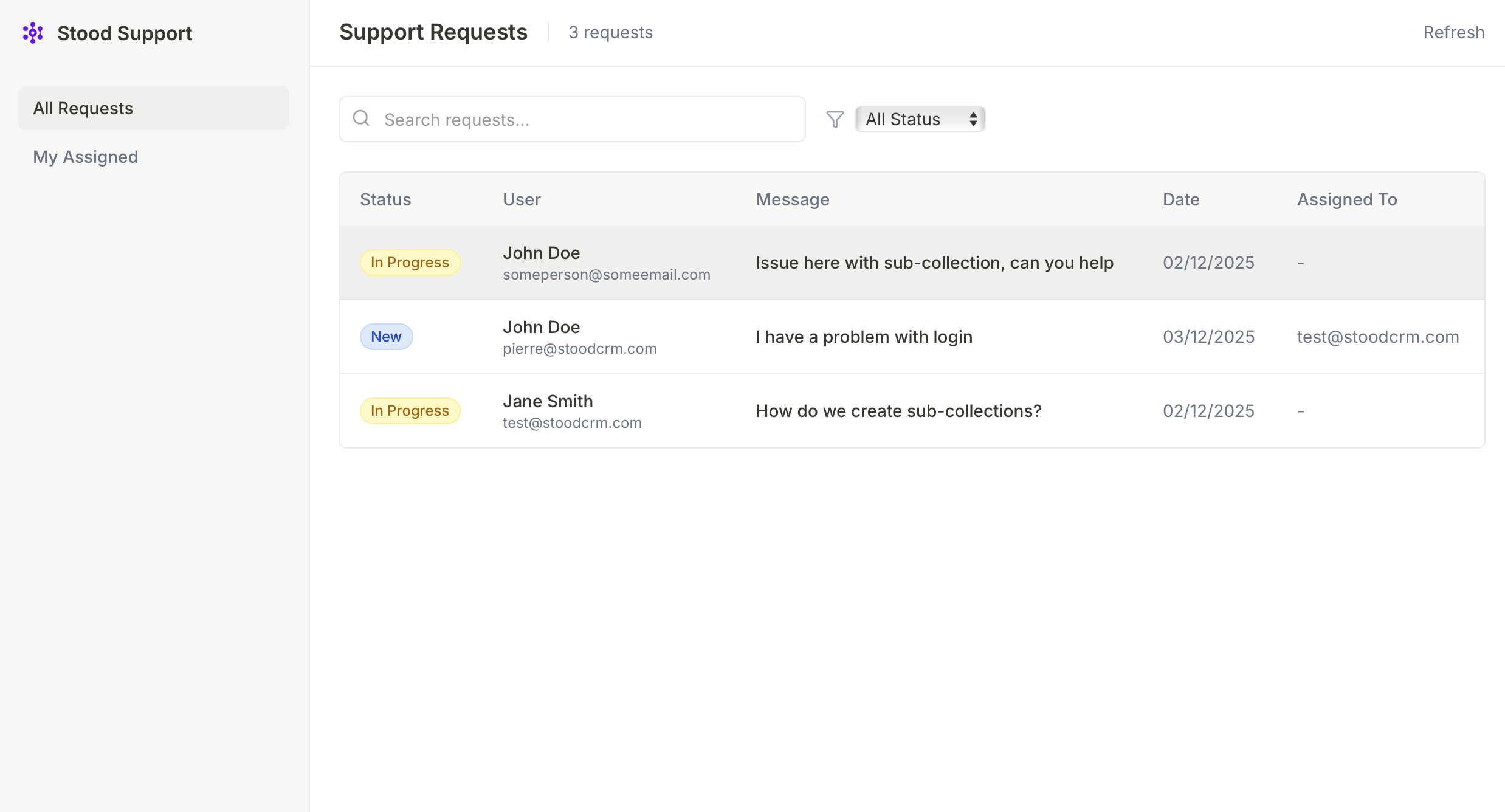
MVP focused on requests management
The Experiment
Objective: Build a dedicated "Support Request Management" app linked directly to existing CRM contracts.
The Constraints:
We didn't want to bloat our core CRM with niche features.
We wanted a specific, simplified UI for support staff who don't need access to the full CRM data.
We wanted it done fast.
The Process:
Core Setup (3 Minutes): We used Stood’s "Sub-collections" feature to define a new data structure called "Requests" attached to our existing "Contract workflow".
AI Construction (25 Minutes): We prompted an AI coding editor to build a fresh, specific UI to handle these "requests".
Result: A fully functional, scalable, and tested MVP in under 30 minutes.

The blue effect means AI is browsing and testing the app by itself (Antigravity here)
Why It Worked: The Power of Sub-collections
The secret sauce here isn't just the AI; it's how Stood’s architecture empowers the AI to focus on what it does best.
Usually, when you ask an AI to "build an app," it has to hallucinate a database schema, write boilerplate API code, and figure out how to store users. With Stood, we skipped all of that using Sub-collections.
What is a Sub-collection? Think of a Sub-collection as a way to "backpack" extra data onto your main CRM records without needing a degree in database engineering.
Simple Definition: You define a list of items (like "Milestones," "Deliverables," or in our case, "Requests") nested within a Deal.
Instant Backend: Once defined in a simple JSON config, Stood automatically generates the necessary database structures in Firestore.
Automatic Sync: These items are immediately synchronized to BigQuery, meaning your new "app" data is analytics-ready from day one.
Because Stood handled the Authentication, Data Model, Sharing Rules, and Runtime, the AI assistant didn't have to worry about the plumbing. It could focus entirely on building a beautiful, functional frontend that interacts with the Stood API.
The Outcome: Clean Core, Limitless Extensions
The resulting app is very qualitative. It allows support agents to view and manage requests without navigating the complexity of the full sales pipeline.
This highlights the core philosophy of Composable Enterprise CRM:
Keep the Core Clean: Your CRM stays composable, sustainable, and focused on pivotal data.
Extend at Speed: Use GenAI to build specific extensions for specific user categories (like high-volume support handling) in record time.
Why not just add this feature to Stood?
We could have simply managed "requests" inside the standard Stood UI using the same sub-collection feature. However, volume-based use cases often require specific interfaces.
Building every possible edge-case feature into the core product creates "bloatware"—software that does everything poorly and nothing well. By leveraging Stood as the data platform and GenAI as the builder, we get the best of both worlds: a lean, powerful CRM and bespoke tools for every team.
Access Blueprint project source code : https://github.com/Hway-Digital/stood-support
Interested in Composable Enterprise CRM? Let's discuss!