
Controlling Value vs Costs for CRM (+AI) Activities
The shift to the Agentic era—anchored by platforms like Salesforce Agentforce and Data Cloud—introduces a massive paradigm shift for enterprise architecture: variable consumption costs. When your CRM budget scales automatically with every AI action and real-time data processing event, predictable budgeting goes out the window.
In a multi-org environment, managing this modern financial reality requires true engineering discipline, architectural guardrails, and real-time visibility. Waiting for annual true-ups or retroactive contract negotiations is a recipe for fiscal disaster. To stay ahead, architects must introduce a structured FinOps practice directly into their deployment lifecycle.
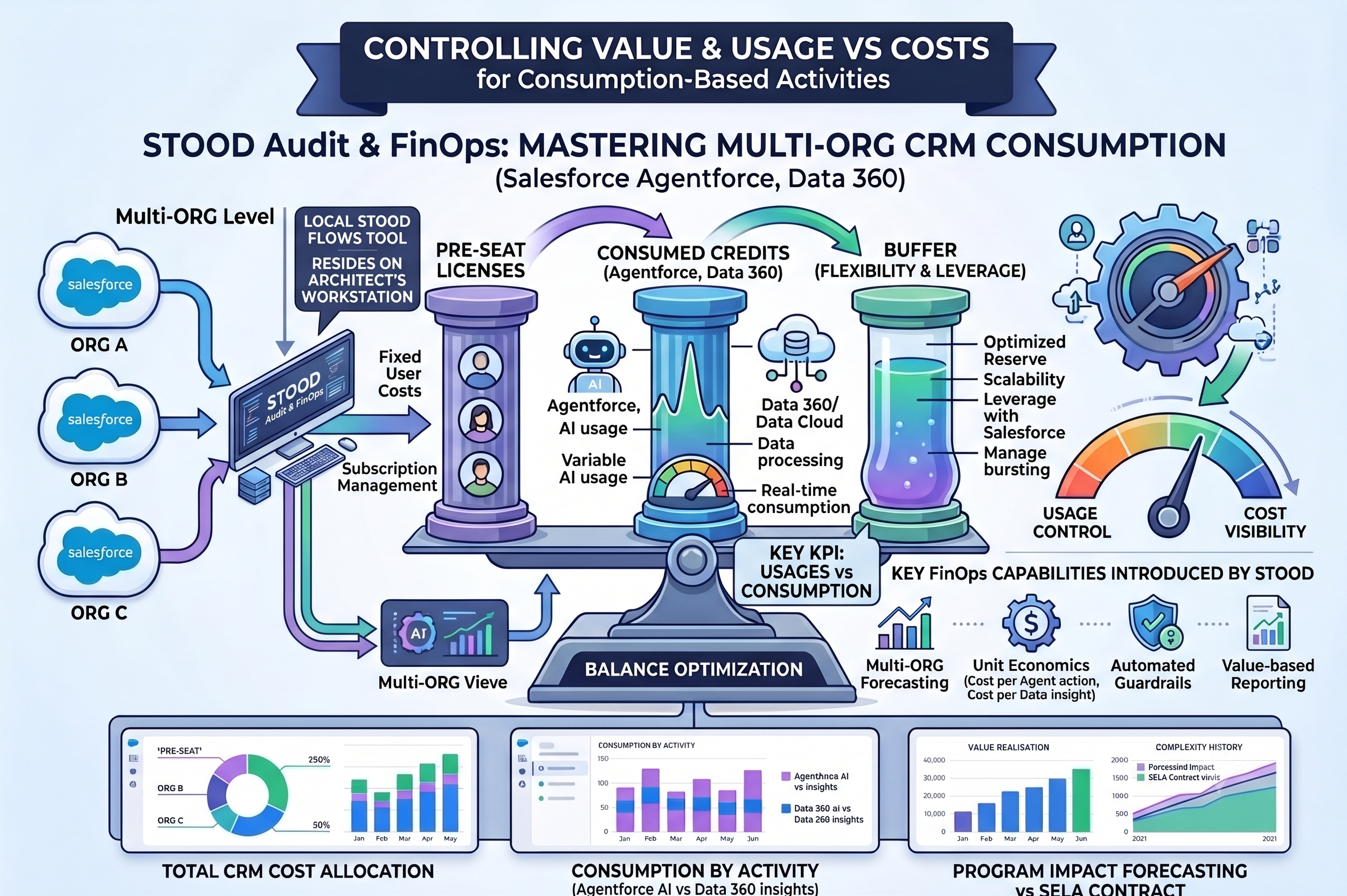
The Multi-Org CRM Consumption Scale
To successfully optimize your modern CRM investments, you must treat your tech stack as a dynamic balancing act. Enterprise environments no longer operate on simple, static seat calculations. Instead, they require a constant calibration between three competing forces:
Pre-Seat Licenses (Fixed User Costs): Your baseline infrastructure costs. These are your standard user licenses, developer tiers, and structural operational minimums that form the predictable floor of your ecosystem budget.
Consumed Credits (Variable AI & Data Usage): The variable engine. This includes Agentforce execution, variable AI tokens, Data Cloud processing metrics, and real-time query executions that fluctuate dynamically based on live business actions.
Strategic Buffer (Flexibility & Leverage): Your elasticity framework. A calculated margin providing organizational flexibility and commercial leverage, optimizing reserve scalability while cleanly managing unpredictable bursting.
Why Traditional Monitoring Fails Multi-Org Scale
Most enterprise architectures distribute workloads across several disconnected orgs (e.g., Org A, Org B, and Org C). Standard vendor analytics tools treat these units in isolation, forcing architects to aggregate data manually via spreadsheets or external BI tools. By the time a billing spike is identified, the capital has already been consumed.
Furthermore, security constraints frequently prevent organizations from pushing deep metadata or operational analytics to third-party cloud aggregators. Financial visibility shouldn't require creating a brand-new compliance risk.
The Architectural Imperative: Local and Privacy-First This is why we built Stood to run locally on the architect's workstation. By auditing and analyzing metadata and metric flows straight from the source without routing sensitive system contexts into external clouds, you maintain complete data sovereignty while gaining total cross-org transparency.
Pragmatic FinOps Capabilities Introduced by Stood
Transitioning from a passive observer to an active governor of your CRM roadmap requires four foundational capabilities natively engineered into your workflow:
Multi-Org Forecasting: Look beyond single instances. Synthesize historic usage metrics across production environments and sandboxes to build models that predict enterprise-wide credit drawdowns.
Granular Unit Economics: Go deeper than total spend. Stood enables teams to pinpoint the exact cost per specific AI Agent action or individual data insight, unlocking true value-based optimization.
Automated Guardrails: Establish programmatic fences. Detect runaway recursive loops, unoptimized data syncs, or anomalous traffic patterns to stop credit bleeding before it manifests as a massive invoice.
Value-Based Contract Reporting: Reconcile daily real-world activities directly against your Strategic Enterprise License Agreements (SELA) or consumption pools, shifting leverage back to your procurement teams.
Bridging Usages vs. Consumption
The core KPI for modern enterprise systems is the strict validation of Usages vs. Consumption. It’s no longer just about whether your teams or customers use the system; it is about evaluating if the value extracted from an automated AI step balances out the real-time processing credits it consumes.
Complexity in the agentic era is inevitable. Unpredictable operational costs are not. By deploying a dedicated FinOps engineering framework, you eliminate shelfware, contain credit bursting, and transform your CRM from an unpredictable cost center into a lean, highly optimized engine.